Friday, November 21, 2014

Photos of Lumbini

IT was 28C and hazy all day today, but we managed to see much of Lumbini park.  I made a huge miscalculation on how far one has to go to see all of the temples here.  We failed miserably at the end of the day in getting either a rickshaw or a minims back to town so we walked about 5km back in the dirt. There were also tons of police, army and special forces out, likely due to SAARC happening next week.  They are making a presence before all the dignitaries arrive.  The police seem to carry black sticks but the army guys have full-on AK-47 rifles.  As I walked by them I couldn't fathom what would have to happen in order for them all to need to open fire with one of those suckers?

Ezina was here a little while ago and has seen changes already-- not only is construction happening for SAARC there is also a continual building and upgrading of the existing temples. There is so much land here it's goig to take awhile to fill up.

The basic premise is that many Buddhist countries and some non-Buddhist countries (i.e. France or Germany) have built their own temple in the style of the architecture in their country.  The vast iterations of Buddha are really interesting, both for the pose or face they chose to put on him, but also the materials from which he is made.  Generally it would be gold but we saw one really large copper Buddha in a stark white, marble circular hall with heavy black pillars all around and a copper lotus on the ceiling.  It was a really interesting and calming place to walk into.  

The others used colours or just placement (such as many paintings, or mini statues or statues in the water what have you) or lots of gold gilding to represent Buddha.  There were throngs of Indian and Nepali school children moving en masse to and fro.  Many said hello to us, or where are you from, a few asked for our pictures which is still weird to me.  I was joking with Ezina that everyone thinks she's Canadian now because they all try and speak to her in English when we're together.

Overall it was a really fascinating place to visit and I am thankful Ezina took us down here because I probably wouldn't have made it here on my own.


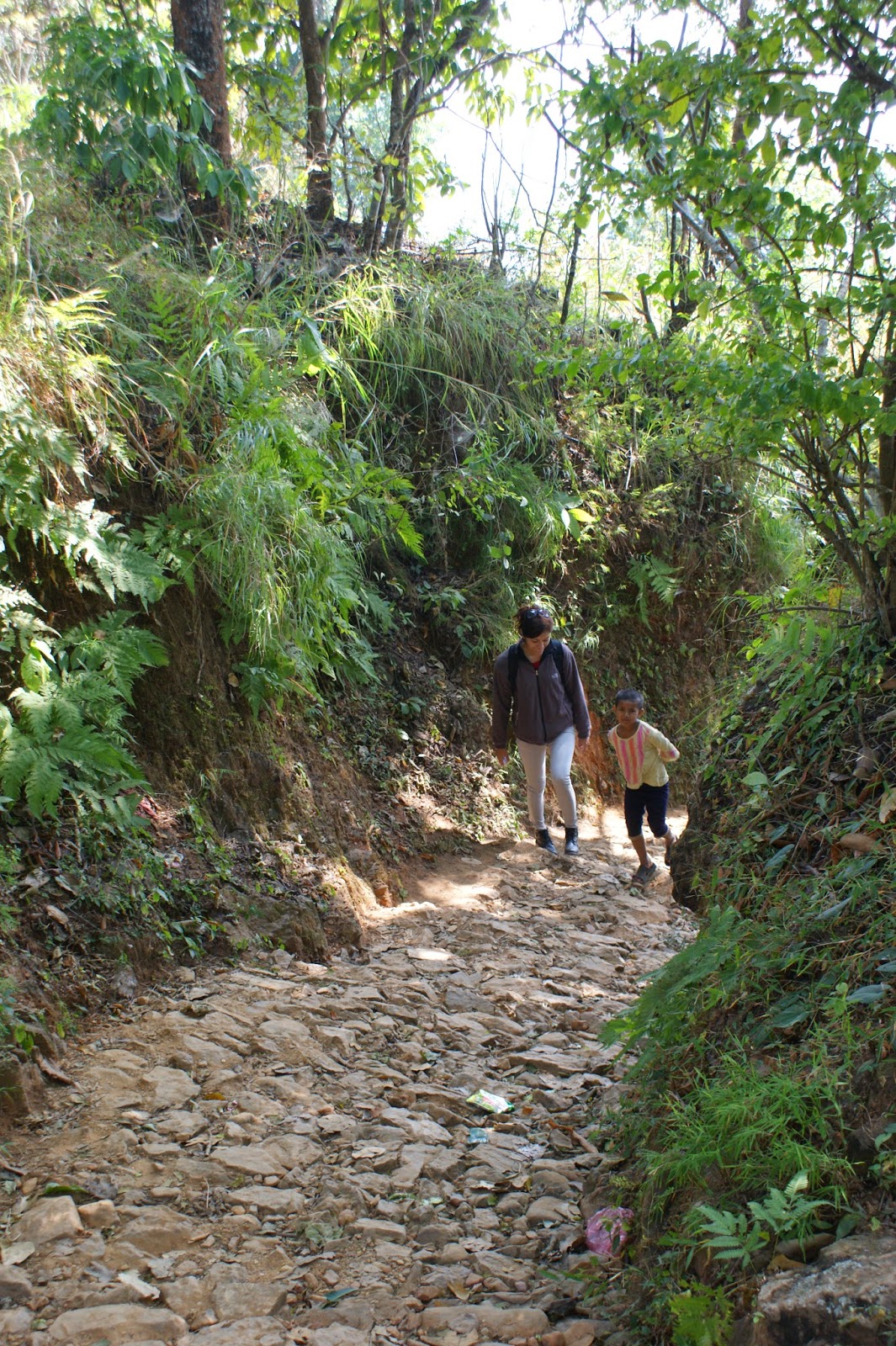
At the risk of sounding like a wimp or a broken record, this picture captures a little of how far one has to
walk to get around this place.

If I look like a sweaty mess its because I was one.


The ever lovely Ezina.

Thursday, November 20, 2014

To Lumbini, the birth place of Buddha

So this is what flat looks like...
Since we are all done our field work and Ezina took the whole week off from her ‘real work’ running her school and being a student, she thought it would be fun to go to Lumbini where Buddha was born.  It’s about a 4-6 hour bus ride from Pokhara but only about 4 hours from Tansen, and it is also about 10km from the Indian border.

We took local buses all the way here which admittedly is worth the price of admission, about $2 to get all the way here, but not without a sore back and a headache.  I really can’t complain too much, it was cheap, they drove slowly (not the one coming down off the mountain, I thought we were done for) and we really didn’t have to wait very long for any of the 3 buses.

The landscape quickly changed after we coasted down the final mountain pass. It’s flat here, and hot, and the roads are long and wide.  We went through Butwal and basically it looked like one big sprawling city divided in two by the highway.  The guidebook suggests there’s no reason to stop there, and I can see why.  The rice fields are also larger and the stacks of rice chaff are much larger which means a bigger crop.  There’s also bananas!

Baby Buddha Statue
Lumbini is a real pilgrimage destination for people of the Hindu and Buddhist faiths and the 2.5km by 3km site itself has a long history of temples and other shrines being built over the last couple thousand years in reverence to the great Lord Buddha.  Today we went into the Maya Devi Temple, the very place where Siddhartha Guatama or the Buddha is said to have been born in 563 BC.   

Thanks to the SAARC meeting, things are being fixed up, or built for the first time, like a metal tent structure that blocks where you put your shoes to go into the temple.  We saw about 15 people in one of the giant ponds cleaning out the weeds, and I couldn’t help but wonder about the other giant ponds all over the grounds that are really overgrown… is there enough time or is the visit going to be so precisely staged that no one will notice most of the grounds need some sprucing up too?

Anyhow, today was mostly a bus day and then a short jaunt into the grounds, so tomorrow we’ll have a bit of walking to do to cover the big long walk down to the rest of the temples which will be really interesting I am sure.


At the Maya Devi Temple.

Wednesday, November 19, 2014

Downhill, uphill, uphill downhill… done

Ezina and I wrapped up our 11th interview here in Tansen which makes 69 total which means Team Ashley’s Thesis has exceeded all expectations!

When I was doing last minute planning with my prof in September and all my plans were slowly crumbling apart, I literally couldn’t imagine even getting ten interviews. It seemed an insurmountable task to reach the 60 that I laid out in my thesis plan that was based all around working with this one group my other advisor had linked me in with.  It would have been way easier had that worked out because we wouldn’t have had to sweet talk so many ‘friends of friends’ into trusting us enough to introduce us to the community they work with.  I think that there is quite a lot of writing on the ‘community entry’ part of research, and it’s for good reason.  Each person you meet has zero knowledge of who you are, what you really want, and has zero trust for you.  You have to earn it.

My profs kept assuring me that once I got here, things would happen. I’d meet people, the lay of the land would become more clear and I’d be able to make something happen. And they were right. 

My one contact in Kathmandu turned out to be amazing and the classmate I met just weeks before I left pulled through with a few other solid contacts as well.  Throw in a couple of brilliant and tenacious research assistants to help with translation and logistics and all of a sudden 6 weeks later we have gone to far flung corners to meet with farmers in a commercialized market who had really interesting stories to tell.

Since we only got 7 of an expected 10 interviews Monday and Tuesday, today we took an overpriced taxi out of town to a small village and met with Gopal who works in project coordination for an NGO.  He took us down a short way to a lady farmer who has aspirations of being the president of a yet to be formed women’s group. This Saturday they meet to work out the details.

Then we went back up to the road, and then up--without exaggeration-- the steepest longest hill yet.  We came across a few farms and paused to talk and as I was looking around wondering when the hike was over, it appeared no one was around for most of the farms we passed.  Dread consumed me… were we hiking all the way up here to find out the rice harvest had stolen our farmers once again?

But then, further, further up we arrived at the courtyard of a large house and were invited to sit down.  One by one women and men came out from various buildings smiling, offering Namaskars and pulling up chairs.  We had a lovely group of ten or so people with 4 serious vegetable farmers to interview.

The interviews went really well.  The group was comfortable sharing with us as they had experience with outside researchers because they had had visitors from Bhutan, America and beyond.  One farmer was a rather large seed and vegetable farmer so I think that’s where the interest has been in the past. Seed is a huge issue here in Nepal because of limited supply of quality, local stock. Often farmers buy seed that has been adulterated at the processor or retailer, or they get a good seed one year and can’t get it the next.  To have a local seed cooperative is a huge plus for the surrounding villages.

We stayed for tea after two interviews at the first house, and then we all walked over to the next lady’s place and did the last two.  Then one of the first ladies came out with a new baby to show off, and asked to have her Polaroid taken with him, after which the grandpa also wanted one. 

After those interviews were done, Gopal offered to take us 40 minutes by bus and another 40 minutes walking to another area, but by then it was 2:00pm and we thought maybe that was out of scope for the day. So we took Gopal out for lunch at a roadside stand.  For three ‘mains’ and two boiled eggs with hot sauce it was 170 rupee, or about $1.70.


This time getting back to the guesthouse in Tansen was much easier because we got lucky with a bus ($0.25 each) coming by and then a jeep ($0.60) to take us the rest of the way as opposed to the 1.5 hour uphill hike like the last couple of days.  It was the best 85 cents I have spent yet.

Tuesday, November 18, 2014

It ain’t easy

Today we set out at a decent hour after having Man, the homestay owner argue for a cab to take us not very far to the village we had a list of contacts for today.  It seems no one wants to take anyone anywhere without being overly paid in this town.  So fine, we decided on a taxi for 600 rupees and headed on down the road.

In the car, Ezina tried the first name and after about 5 minutes of conversing found out the person we were seeking was out harvesting rice.  The next name held the same story and some numbers didn’t work, so we decided just to get there and see who was around.

The ups and downs of field research
come with some nice views!
We were quite lucky that the first farmer we found in the village was on the list and knew what we were there for. His interview went really well and he had some good perspectives to share.  This area is much more organized into cooperatives that collect and group market their product. So long as those in charge are giving the right prices, the farmers completely get around the ‘trader’ roadblock the other farmers we’ve talked to have, as far as getting decent prices for their product.

This man went through our list and deciphered that all four other contacts were out harvesting rice, and they were about a 1.5 hour walk from where we were.  The sad reality is that Ezina and I are willing to walk, but 1.5 hours to ‘see’ if they ‘maybe’ wanted to talk to us seemed a bit out of our comfort zone.  I kept thinking how lazy we are because those farmers probably walk there every day with loads on their backs but anyway… we’re researchers, not farmers!

He offered to take us to a neighbor, Laila, who actually was on out list so that was a good coincidence.  We conducted the interview with 11 good-sized chicks scurrying around our feet.  She too had some good perspectives including that she is co-head of household with her husband.  When she was younger it was felt that girls shouldn’t be educated so she wasn’t literate but was happy to share that her daughter is in her second year of her bachelors degree. 

The collection centre of one village. The chart shows
planting times, rates, and all the other information
they need to know for a whole slew of crops.
Again, at the end we asked if there was someone else they know that we could talk to that was a ‘professional farmer’.  I’ll take a pause to point out that this ‘sampling frame’ is perfectly legitimate.  It’s called snowball sampling until you reach your number, or quota or what have you. When you read all the complicated statistical sampling frames you can develop, snowball technique sounds like utter hog wash but then you get to Nepal, with all your plans sanctioned by your advisor and your ethics committee and photocopied out on crisp white paper, and you think yes, this is going to happen.  Then enters the NSS, the Nepali Shit Show effect to completely obliterate your lovely plans.  So what to do but try and find anyone and everyone who fits your inclusion criteria?  
Jus' chillin'.

But I digress.

We finished up the three interviews and decided to walk the 1.5 hours uphill back home. I think I broke Ezina’s legs, poor girl. But in my defense I don’t even think a bus passed us going our way!

And anyway, isn’t walking not only good exercise but also good for your mental health?  We should be really, really healthy after this trip.


One of the streets of Tansen.

Monday, November 17, 2014

Roadside noodles

Ezina and I traveled by car to Tansen (a.k.a. Palpa) on Sunday so we could be here for 3 days of interviews (we hope!).  Today was a success.  We made contact with someone from Heifer International (an old contact of my classmate Rajan’s) and he had sent me an excel spreadsheet of 10 names for 2 days worth of interviews.  It was very exciting to be working with someone who was so organized!
Once an actor in India, this man is now
 a leader in his community. 

We met him briefly this morning to go over logistics of getting to this small town outside Tansen as well as hear about what made these farmers more commercialized. The list of names he gave us was a good group for various reasons, the first being that it was mostly men we would interview. Up until now I really have no idea why, but the men seem to be absent from the farming scene (*in the limited group of people we have talked to). Most men have jobs off farm, some women said their husbands ‘do nothing’ and some are abroad. We have only thus far interviewed 2 other farms where the man was as involved as the woman.

After waiting forever for a bus that would take us halfway, we were continually told that all seats were ‘reserved’ for those going to Pokhara, so we caved and spend 700 rupees to go about 40 minutes over to the next small town from which would could walk. 

And walk we did. It was a Nepali 30 minutes, which according to some people we passed by was going to be either 2-3 hours or 40-50 minutes.  Thankfully it was the latter.

These farmers were totally worth walking to talk to. They were proud, educated, engaged in farming, and really thoughtful people to spend some time with.  And they were all really successful for different reasons.  My favourite interview, while they were all great, was the 65 year old man who was adamant that his daughter in law was the head of the household, and was in charge of all the financial management and otherwise. It was a nice thing to hear not only from a gender perspective but also that the next generation was taking over.

Project funding from USAID has helped this farmer expand his crops
and make more money off the land.
The first man we talked to was insistent that the training he has had is good, but implementing is what made him successful.  He was also one of the early adopters of growing vegetables in his area, and since, has become an expert and a leader in the community. He works with the local ag office to run trials and advise on what seeds are good for the area. He also grows his seedlings in trays, which is a relative novelty around these parts.  Micro-irrigation has also really helped since they find lack of water is a limitation to expansion of crops and into new land.

The last guy’s farm was on the way back in the direction of the town where we could catch a bus back to Tansen, so we obliged a visit. That morning we had arrived in the village at about 10ish and were already hungry due to a stale breakfast of bakery goods, and sadly no one had us for lunch, so by 4pm when we were ready to leave, we were completely starving! And we were given about a kilo of oranges from different people so on top of my already heavy 2 cameras, paper, books, wallet, apples and whatever else was in my bag, I had that to lug around too.
Catching grey water and other run off for the micro irrigation

His farm was ‘just up there’ which again, is a Nepali ‘my farm is really close’ and I figure we hauled butt up about 1 km of narrow little footpaths to see where the magic happened.  It is really sweet to be a complete stranger in a foreign land and be invited to see someone’s homestead.  After we were done with his interview, we found the Nepali staple, dry noodles filled our bellies enough to get us home.


Anyhow tomorrow will see us heading a little farther afield into the Palpa countryside, so I will be sure to update you with the story tomorrow!

As always, thanks for reading. 


We walked pretty well as far as that bright green patch… and this was about the 2/3 way point to get there!

75 rupees for 2 noodle bags and 2 bottles of water. Nothing but the best!